
Searching Spokane County Civil Dockets
Superior and District Court matters both have a starting point. The Spokane County Court Viewer is it. The District name route pulls civil, small claims, and name changes into one group. The Superior route gathers civil, domestic, and probate cases. Both keep those categories apart from criminal searches. Name forms usually want a last name plus a first initial. Copy the case number with all its punctuation for the best match.
Spokane Superior cases also appear through the Odyssey Portal. It offers Smart Search along with hearing and judgment searches. The Washington Courts search serves as a statewide locator. Its data can lag behind clerk entry and stay incomplete. Rely on the court of record for current documents.
- Identify Superior or District Court from the filed notice.
- Select the matching civil case-type path.
- Search by exact case number or party name.
- Compare the caption, filing date, and court before opening.
- Ask the proper clerk for the needed document or certification.
Spokane Civil Jurisdiction Split
Spokane County Superior Court is the general-jurisdiction civil court. Its docket mix covers personal injury, unlawful detainer, domestic relations, parentage, probate, and guardianship. Spokane County District Court is different. It works within limited jurisdiction and handles civil matters, small claims, civil infractions, and name changes. Spokane Municipal Court states this plainly. It hears no ordinary civil suits, no small claims, and no name changes.
| Need | First court route | Main limit |
|---|---|---|
| Major civil or domestic case | Superior Court | Images may require Clerk access |
| Small claim or name change | District Court | Use the civil category |
| City civil infraction | Municipal court | Only within city jurisdiction |
Spokane Valley contracts with Spokane County for District Court services. Liberty Lake and several smaller cities follow the County District route too. So search by filing court, not by where the dispute arose.
Inside a Spokane Civil Docket
A Spokane County civil docket opens with a case header. The case number and court sit there. So do case type, filing date, caption, status, and judicial officer. The chronology that follows can list a complaint or petition. So can responses, motions, notices, orders, settings, judgment events, and later enforcement work. Odyssey breaks the display into case information, party, disposition events, and events or hearings. One caution applies. A document title in that history does not mean an anonymous user can open its image.
| Case number | The court identifier; Superior filings use XX-X-XXXXX-XX with hyphens. |
|---|---|
| Parties | Plaintiff and defendant, or petitioner and respondent. |
| Filings | Pleadings, notices, motions, and orders indexed by date. |
| Setting | Date, time, courtroom, type, official, and status. |
| Judgment | A recorded judgment event; obtain the actual order for its terms. |
Spokane History Versus Documents
Think of a case history as a roadmap. It can show that a motion, order, or judgment was entered. The filed pages do not appear. Odyssey's anonymous access covers public case information. The official FAQ says documents are not available to anonymous users. For Superior document images, County Clerk authorization and access role govern access. District Court runs its own case-document and request routes.
Use the docket as a locator. Write down the case number, document title, and filing date, then request that item from the correct clerk.
Need a complete or certified Superior record? Contact the Spokane County Clerk of the Superior Court. For a District civil or small-claims file, reach the District Court clerk. A targeted request keeps a calendar line from being mistaken for the signed order itself.
Civil Case Types on the Docket
Categories on a Spokane County civil docket reflect both the subject and the court's jurisdiction. The label routes your search, nothing more. It says nothing about who prevailed. "Civil - PERSONAL INJURY" marks a kind of lawsuit, not an award. "Civil - UNLAWFUL DETAINER" works the same way. It names a case classification. That label proves neither a judgment nor any current right to possession.
- General civil claims filed in Superior Court.
- Personal injury and unlawful detainer matters.
- Domestic relations, parentage, and family proceedings.
- Probate and guardianship cases held by the County Clerk.
- District civil, small-claims, and name-change matters.
Family and guardianship cases can carry a public case index while confidential financial, health, treatment, or personal information stays restricted. Read the event name and its access rule as two separate things.
Spokane Family Motion Dockets
Family-law motion settings get their own calendar. The Superior Court assignments page publishes Tuesday through Friday family-law motion dockets plus a child-support modification docket. Commissioner rotations, judge assignments, daily courtroom assignments, and coordinator contacts appear there too. That detail beats a general civil date list. A family matter may land before a commissioner. It may also sit on a named motion calendar instead of a broad civil trial schedule.
Washington General Rule 22 keeps many family records open at a baseline. It shields listed confidential information forms, sealed financial source documents, health records, and treatment reports. A public setting can show up on the calendar. Those restricted materials stay out of view.
Civil Docket Settings and Hearings
District civil calendar rows list name, time, case number, location, hearing type, case type, official name, and status. Superior rows add start date, date sort, and end date. Jot down all of it. A hearing line may miss the assigned official or courtroom. That can leave you in the wrong place.
Status matters too. Scheduled means the event stayed on the list at the last update. Held reports that the event occurred, not its result. Not Held-Continued and Not Held-Canceled both say the old event did not proceed as listed. A moved setting often shows up as a new row. The old one lingers in history. Take the Spokane County court dates route. Confirm current settings with the clerk or coordinator.
When Spokane Civil Search Fails
A no-result screen should prompt a route check, not a shrug. Confirm the filing court and the civil category. Check the party spelling and the first initial. Mind the case-number hyphens and the date range. For Superior work, try both the County Viewer and Odyssey. A Spokane Municipal search will never surface an ordinary civil suit or small claim. And a state-court search cannot disprove a federal civil case.
- Retry the exact case number with its punctuation.
- Switch between Superior and District civil paths.
- Test an alternate name spelling or wider filing range.
- Ask the clerk about archives or pre-electronic files.
- Ask whether access is sealed, confidential, or restricted.
Never treat an empty web response as proof that a civil case ended or never existed.
Civil Docket Access Rules
Washington General Rule 31 spells out what counts as a court record. The list covers indexes, calendars, dockets, and registers of actions. Judgments, minutes, and case-management data count too. So a Spokane County civil docket falls squarely inside the definition. Your right to look at these materials still bows to other laws. Court rules and orders may apply as well. Walking into the courthouse to inspect a file is usually free. The fees start with paper and certified copies.
Protected records: GR 15 controls sealing and redaction. GR 22 restricts listed family, protection-order, guardianship, financial, health, and treatment information.
A case caption being public does not mean every paper in the file is public. Some material sits behind restrictions. The clerk can ask for identification or a request form. A court order may be required too. Check with the clerk's office for the current access rules before you plan a visit.
Spokane District Civil Search
Civil cases in Spokane County District Court get their own name search, separate from the criminal side. The court's official District Court civil search page covers civil suits, small claims, and name changes on one screen.
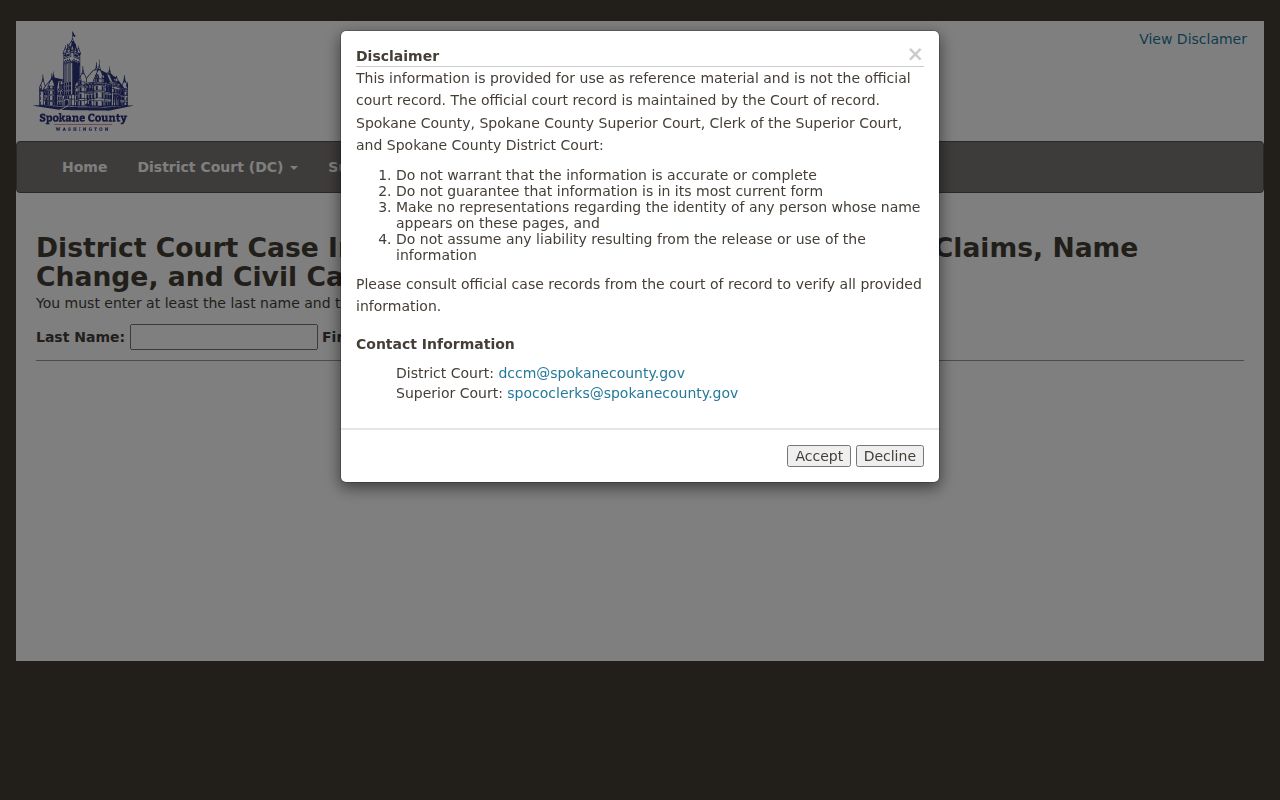
Picking the civil category is part of the search itself. Enter a name on the criminal path and you may get a blank result that looks like no case exists, when the file is actually sitting in the civil docket.
A good request names one document. It should name the filing date too. Ask for the complaint, a specific motion, the signed order, or the judgment. Not every docket event has a public image. Narrow beats broad. Older Superior Court files may live on microfilm. An archived case can require clerk work before you can view anything. If simply reading the file at the counter would serve you, ask about that first. When you need a certified copy, check the current fee schedule with the court that holds the Spokane County civil docket.